

Impact-resistant buffer structure extends the service life of mining rubber wear-resistant parts
Impact Loss Scenarios and Industry Pain Points of Mining Rubber Wear-Resistant Parts
According to the 2024 statistical data from the China Mining Machinery Association, the impact wear of rubber wear parts accounts for 28% of the total wear of mining wear-resistant fittings, making it one of the core components of operation and maintenance costs. In mining operations, rubber wear parts are widely used in various links such as crushing, conveying, ball milling, and flotation, but their wear rate has always been a common problem in the industry. Taking the buffer bar at the feeding point of a belt conveyor as an example, when ore falls from a chute at a height of 30 meters, the instantaneous impact load can reach more than 1.2×10³ N. An ordinary solid rubber buffer bar has no stress dispersion structure, and the impact energy directly acts on the surface of the rubber layer, causing cracking and peeling of the rubber layer within 3 months. A single replacement requires a 4-hour shutdown, the procurement cost of a single buffer bar is about 1,200 yuan, and the annual replacement cost exceeds 15,000 yuan. Another example is the ball mill cylinder liner. When grinding iron ore, the high-frequency impact between steel balls and ore causes stress concentration on the surface of the liner. The average service life of ordinary rubber liners is only 3.2 months. A medium-sized iron ore mine spends more than 600,000 yuan annually just on replacing ball mill liners, and the loss of ore transportation and mineral processing capacity during shutdown for replacement can reach 120,000 yuan per day. Such impact wear not only pushes up operation and maintenance costs but also affects the overall production efficiency of mines due to frequent shutdowns, becoming a painful point that mining enterprises are eager to solve.
Design Logic and Performance Parameters of Impact-Resistant Buffering Structure
The core principle of the anti-impact buffer structure is to disperse impact stress through layered composite, built-in damping units or special-shaped structures, converting instantaneous impact energy into elastic deformation energy to avoid stress concentration acting on the surface of the wear-resistant layer. At present, the mainstream anti-impact buffer structures are divided into three categories: the first is the honeycomb buffer hole structure, that is, uniform honeycomb holes with a diameter of 10-15mm are opened inside the rubber base material, and the impact energy is absorbed through the elastic deformation of the hole wall, with an impact absorption efficiency of 82%-87%; the second is the layered composite structure, that is, the surface layer is made of high wear-resistant rubber with a Shore hardness of 65-70, the middle layer is made of high elastic buffer rubber with a Shore hardness of 50-55, and a nylon fiber reinforced layer is added to the bottom layer to improve the integrity of the structure; the third is the damping buffer skeleton structure, in which a polyurethane elastic skeleton is embedded inside the rubber to further disperse the impact load. Compared with ordinary solid rubber parts, the surface stress peak of wear-resistant parts with anti-impact buffer structure can be reduced by more than 60%, and the service life can be increased by 2-3 times under the same working conditions. For example, the liner of the feed inlet of a certain cone crusher, after adopting the honeycomb buffer hole structure, its service life is increased from the original 2.5 months to 7.8 months, which fully meets the production demand of one mineral processing cycle, and this structure has passed the standard certification of the supporting wear-resistant parts of MT/T 989-2006 "Rubber Conveyor Belts for Mining".
Suitable Solutions for Impact-Resistant Buffer Rubber Wear Parts in Core Mining Scenarios
The impact loads vary significantly in different mining scenarios, and it is necessary to targetedly match rubber wear-resistant parts with anti-impact buffer structures.
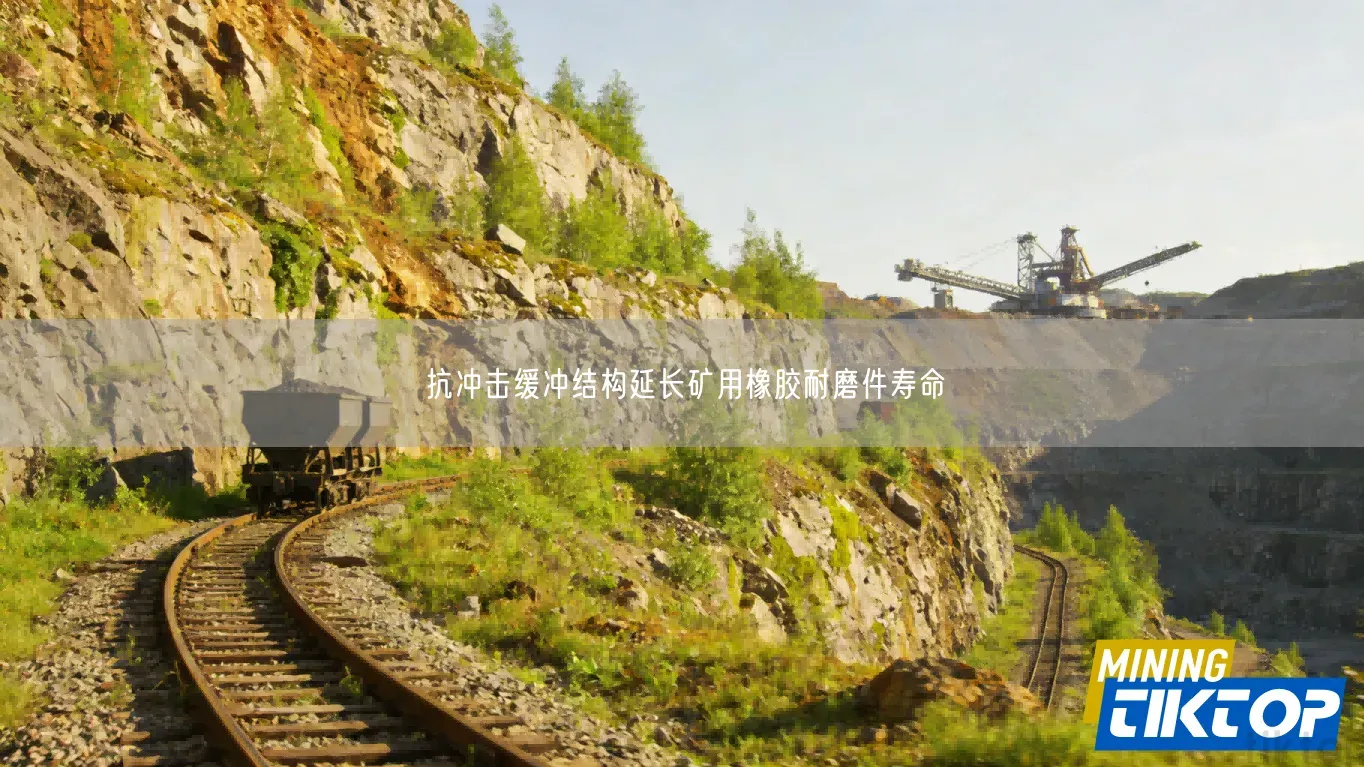
Wear parts of crushing stages: The feed liners of jaw crushers and cone crushers need to withstand the direct impact of large ore blocks. It is recommended to use high wear-resistant rubber liners with honeycomb buffer hole structures. A certain copper mine has an annual processing capacity of 1.2 million tons. It originally used ZGMn13 high-manganese steel liners, which required a 6-hour shutdown for a single replacement, with a replacement cost of about 35,000 yuan per set and a service life of only 1.8 months. After switching to honeycomb buffer rubber liners, the replacement cost was reduced to 22,000 yuan per set, the service life reached 5.2 months, the single shutdown time was shortened to 2 hours, and the annual savings in replacement and shutdown costs exceeded 120,000 yuan.
Conveying section: The buffer bars at the blanking points of belt conveyors and transfer stations need to withstand high-frequency blanking impacts, and it is recommended to use rubber buffer bars with a layered composite structure. For the buffer bars in the transfer station of an open-pit coal mine, the original ordinary rubber bars were replaced every 6 months. After switching to composite buffer bars with an elastic skeleton in the middle layer, the service life reached 18 months, saving over 200,000 yuan in replacement costs annually and reducing downtime by 80%.
Ball grinding section: The cylinder liners and grid plate liners of ball mills need to balance wear resistance and impact resistance, and a layered composite structure reinforced with nylon fibers is recommended. For the ball mill liners of an iron ore mine, after adopting the intermediate buffer layer, the occurrence time of surface cracks was delayed to 4.5 months, and the overall service life was increased to 6.8 months, which is 112% higher than that of the original ordinary rubber liners. Moreover, no large hoisting equipment is required for replacement, and a single person can complete the installation of a single liner.
Flotation and Dewatering Links: Liners for the stirring tanks of flotation machines and wear-resistant rubber pads for dewatering screens need to adapt to high-frequency vibration and medium corrosion. Rubber parts with a damping buffer skeleton structure can effectively reduce rubber layer shedding caused by vibration transmission. At a mineral processing plant, the replacement cycle of dewatering screen rubber pads was extended from 3 months to 9 months, and the acid-alkali resistance was improved by 45%.
Selection and Operation and Maintenance Key Points of Impact-Resistant Buffer Rubber Wear-Resistant Parts
When selecting the type, first clarify the core parameters of the working condition: first, the magnitude of impact load. For scenarios where the blanking height is ≥20 meters, a composite structure of honeycomb buffer holes plus an elastic skeleton must be selected; second, the hardness of the material. For grinding iron ore, high-wear-resistant surface rubber should be selected, while flotation tank liners need to have both acid and alkali resistance, and nitrile rubber substrates are recommended; third, the operating temperature of the equipment. For high-temperature working conditions, aged-resistant hydrogenated nitrile rubber should be selected to prevent premature softening of the rubber layer. During installation, attention should be paid to installing rubber buffer gaskets at the bolt holes to avoid stress concentration caused by direct metal contact, and at the same time, the fit between the buffer structure and the equipment base should be ensured to avoid excessive local load caused by gaps. During the operation and maintenance process, the wear of the buffer layer must be checked every 3 months. If the buffer holes are deformed or the elasticity of the intermediate layer decreases by more than 20%, timely replacement is required to prevent premature damage to the wear-resistant layer due to failure of the buffer structure.
Compared with wear-resistant accessories made of other materials, impact-resistant and shock-absorbing rubber parts have more obvious advantages in scenarios with high impact resistance and lightweight requirements: compared with high manganese steel accessories, their weight is only 60% of that of similar high manganese steel parts, and the installation efficiency is improved by 40%; compared with polyurethane accessories, they have better wear resistance, and the service life is increased by more than 30% under the same working conditions; compared with ceramic accessories, they have stronger impact toughness, no brittle fracture occurs, and they are suitable for impact scenarios of large ore.
Benefit Verification of Practical Application Cases
In 2023, a medium-sized mineral processing plant upgraded the impact-resistant buffer structure of the rubber wear-resistant parts in the entire workshop, covering three core accessories: ball mill liners, conveyor belt buffer bars, and crusher feed liners. After the upgrade, the service life of the ball mill liners was increased from 3.2 months to 6.8 months, saving 420,000 yuan in annual procurement costs; the replacement cycle of the conveyor belt buffer bars was extended from 6 months to 18 months, saving 216,000 yuan in annual replacement costs; the replacement cycle of the crusher liners was raised from 2.5 months to 5.2 months, saving 180,000 yuan in annual procurement costs. The cumulative downtime for replacement throughout the year was reduced by more than 120 hours, corresponding to a reduction in production capacity loss of approximately 14.4 million yuan, and the overall operation and maintenance costs were reduced by 32%. This case proves that the impact-resistant buffer structure can effectively solve the problem of impact loss of rubber wear-resistant parts for mining, bringing significant economic benefits to mining enterprises.
 Highly Corrosion-Resistant Mining Valve Wear-Resistant Parts
 High-concentration Slurry-Adaptable Wear Parts of Ball Mills
 Impact-resistant buffer structure extends the service life o
 Quick-installation Wear-resistant Parts for Slurry Pumps Red